The application is available here for New and Returning Schools. Please complete the application with your team. Applications are due no later than 4 PM on Friday, September 23, 2022. Schools will be notified by early October. Read more below or on the SBIRT Application flyer.
New Schools
Schools can apply to be part of a School SBIRT Implementation Project Cohort 2022-2023. Each school that participates is eligible for a $2,000 stipend upon meeting project requirements. A maximum of $4,000 per district.
Project Requirements
Identify a District Administrator/School Leader to engage in decision-making and problem solving for project implementation.
Identify an existing team or create a SBIRT Implementation Team. The team will be comprised of participating Practitioners, designated Leader/Administrator, and Team Lead.
Selected new staff Practitioners must complete online learning, 1 day of training, practice sample for fidelity review, and regular self-assessments of practice.
Selected staff Practitioners deliver SBIRT to 1-2 new students per month and track data.
Participate in 2-3 virtual follow-up community of practice sessions.
Each team will receive a Google Dashboard to enter their data on a monthly basis for implementation feedback.
Team Lead submits a final SBIRT data tracking sheet to WISH Center Director at the end of the year for project evaluation and reporting.
Returning Schools
This project is open to returning school SBIRT implementation teams or anyone that has participated in School SBIRT training with the WISH Center.
Each school that participates is eligible for a $2,000 stipend upon meeting project requirements. A maximum of $4,000 per district.
Project Requirements for Returning Schools
All of the above requirements.
Returning staff Practitioners must participate in a 2-hour virtual Booster Session.
Optional, training will be available for any additional new team members as described above.
Training and Community of Practice Dates:
In-Person Training for New Team Members (Pre-Learning Required) Choose ONE
2018-2019 Wisconsin School SBIRT Implementation Project Report
Highlights
259 students received SBIRT delivered by 64 staff.
Students received an average of 3.46 Brief Intervention sessions for an intervention “dose” of 70 minutes.
Student response to the Brief Intervention showed statistically significant and clinically meaningful reductions in behavioral health symptoms and problem behavior from initial to follow screening.
44 students were recommended for further services upon completion of the brief intervention.
Student outcomes from this project are consistent with the research literature that shows SBIRT to be highly effective and efficient for addressing adolescent behavioral health issues within opportunistic settings.
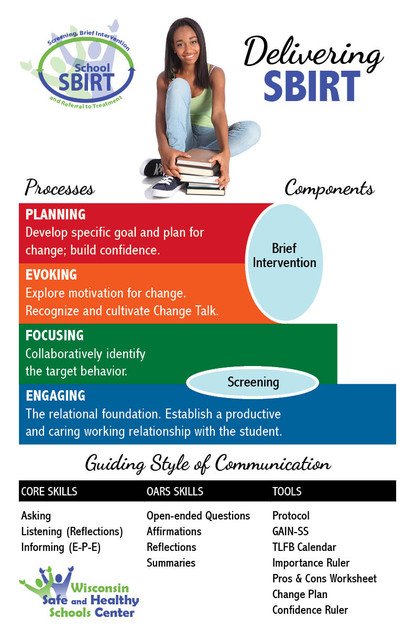
SBIRT stands for Screening, Brief Intervention, and Referral to Treatment. Originally developed for delivery in busy health care settings, SBIRT offers an efficient, evidence-based, and comprehensive service to address selected behavioral health concerns among adolescents (e.g., alcohol/other drug involvement). Although originally designed as a universal prevention approach (Tier 1), SBIRT is readily adapted for delivery in middle and high school settings by existing student services staff as a selected (Tier 2) or indicated (Tier 3) intervention.
Why deliver SBIRT services in your school?
SBIRT is well-established and evidence-based.
SBIRT expands the capacity of student services to effectively and efficiently address a range of behavioral health concerns (e.g., alcohol/drug use, mental health) which, in turn, promotes school engagement and learning outcomes.
SBIRT fits with a student-centered, strength-based philosophy.
SBIRT is student friendly, culturally relevant, and highly engaging. No problem recognition is required for a student to benefit from SBIRT. Teenagers rate these services with high levels of satisfaction.
SBIRT fits with Response to Intervention. Screening provides baseline data, then approximately 30 days later, follow up screening ascertains individual student response to Brief Intervention.
SBIRT fits with Positive Behavior Intervention and Supports. Services can be delivered as an indicated (Tier 3) or selected (Tier 2) intervention. Because of the amount of resources required, this project does not endorse implementation of universal screening (Tier 1).
Implementation allows for flexibility. Staff are trained to use a protocol which guides delivery of services. Staff decide the focus of intervention, number of BI sessions, and format of delivery (individual or small groups).
Who do I contact if I need more information?
For more information about School SBIRT and the Training and Implementation Project, please contact Tracy Herlitzke, WISH Center Director (therlitzke@cesa4.org) or Scott Caldwell, DHS SBIRT Coordinator (scott.caldwell@wisconsin.gov).
Referral pathways are formalized processes for identifying and connecting students to needed mental health supports. These pathways are important because they provide next steps for staff and families after identifying a student in need, coordinate supports within schools and with outside organizations, and improve student outcomes through early identification.
The Global Appraisal of Individual Needs – Short Screener (GAIN-SS) is a tool designed to identify individuals who are likely to have a mental health and/or substance use disorder and who should be referred for further assessment or treatment. The GAIN-SS has 20 questions and takes about 5 minutes to administer. The WISH Center receives funding from the Wisconsin Department of Public Instruction/DHS for up to 50 schools to be licensed to utilize the GAIN-SS online screening tool.
Find guidance on facilitating motivational interviewing-based interventions in group settings with adolescents. View training videos, download intervention materials, get continuing education credits, and explore MI resources.
Provides resources for those seeking information on Motivational Interviewing. It includes general information about the approach, as well as links, training resources, and information on reprints and recent research.
Document created by the Wisconsin DPI on Consent and Notification in a Multilevel System of Support (Response to Intervention): Frequently Asked Questions & Definitions
The Global Appraisal of Individual Needs – Short Screener (GAIN-SS) is an evidence-based, 16-question behavioral health screening tool developed by Chestnut Health Systems that identifies needs for further assessment in the areas of mental health, substance abuse, and anger management for adolescents and adults. This electronic tool has been made available here in Wisconsin through a cooperative effort of the Department of Public Instruction, Department of Health Services, and Wisconsin Family Ties and is appropriate for use by pupil services professionals and community providers.
The Department of Public Instruction is now hosting the GAIN-SS at http://dpi.wi.gov/sspw/mental-health/behavioral-screening-tools/gain-ss. This new home page includes electronic and hard-copy versions of the tool, the GAIN-SS manual, a link to a webcast to learn how to administer the GAIN-SS, instructions for both pupil services professionals and county providers, parent and student consent forms, and links to lists of treatment providers by county.